
the operating system that makes brands cohere.
most companies don't have a design problem. they have a coherence problem. this is the page that explains the difference, names the practice, and shows the system that fixes it.
01. the coherence problem.
most companies don't have a design problem. they have a coherence problem.
the logo is fine. the website looks current. the deck is sharp. every individual piece passes review. but when you put them side by side, the brand reads as five different companies talking past each other.
that's not a taste problem. it's not a discipline problem. it's a system problem. there's no operating system holding the brand together.
the deeper the team, the worse it gets. a founder can hold the brand in their head. a team of fifty cannot. so they outsource the brand to vendors, who each render it differently. the brand drifts. coherence collapses. the next CMO inherits the mess.
this is the coherence problem. we design the operating system that fixes it.
02. what is a BLAK OS.
a BLAK OS is the operating system a brand runs on. not a PDF style guide. not a notion page. a governed system.
strategy, identity, language, perception, and emotional posture, all encoded so every team and every vendor renders the brand the same way.
a style guide is a document. it says "use #154BB5 for the primary blue." then your packaging vendor uses #154BB6 because they didn't have the file, and your video editor uses "royal blue" because they were working fast, and three months later nobody can find the original guide anyway.
a BLAK OS is governance. the token lives in a machine-readable system. every consumer (designer, vendor, AI tool, internal team) pulls from the same source of truth. when a value changes, the change propagates. drift is structurally prevented, not policed.
this is the difference between writing a constitution and running a government.
03. who needs one.
a BLAK OS isn't for everyone. three kinds of company need one.
founders past the napkin stage.
the brand fit in your head when you started. it doesn't anymore. you're hiring, partnering, shipping in three categories, and every week someone asks "what's our voice on X?" you need a system that answers without you in the room.
operators in a scaling company.
the team grew. the vendors multiplied. the original brand book is two years out of date and nobody owns it. every quarter brings a new "brand refresh" conversation that goes nowhere. you need an OS, not another offsite.
AI-era brand owners.
your stack is full of LLMs writing copy, tools generating images, agents publishing content. none of them know what your brand is. you need a BLAK OS the machines can read: JSON, tokens, governed prompts. otherwise every AI output is a tiny act of drift.
04. the five pillars.
every BLAK OS we build starts with five discovery pillars. they're the diagnostic layer: what the brand believes, how it's perceived, where it sits, how it speaks, and what it makes people feel.
-
belief.
mission, vision, values, thesis. what the company is for.
-
perception.
how the market currently reads the brand. the gap between intent and reality.
-
market position.
where the brand sits among competitors. what it owns. what it ignores.
-
language.
voice, diction, rules. the literal words the brand uses and the ones it refuses.
-
emotional drivers.
what the brand makes a buyer feel. the internal posture that drives every external rendering.
five pillars × an interview-heavy diagnostic phase = a complete picture of the brand's current state, encoded as data. that's the foundation everything else governs from.
05. what we ship.
discovery becomes deliverables. four modules ship as part of every BLAK OS engagement. scope them tightly or fully. they're built to govern as one system, not function as four independent vendors.
-
brand module →
strategy, identity, naming, brand systems. the diagnostic and governance layer of the OS.
-
web module →
websites built to be governed at runtime. tokens, components, content collections, all OS-driven.
-
packaging module →
structure, surface, retail-ready. plus print, signage, and environmental. every physical surface.
-
social module →
brand-led video, photo, social. monthly cadence or one-off. output that holds the OS at runtime.
each module ships with its own tokens, rules, and rendering specs, all writing to the same OS. no hand-offs between agencies. no tribal knowledge in someone's email. the system holds.
06. how an engagement runs.
a BLAK OS engagement runs in four phases.
- 01
diagnostic.
interviews, audits, the 5-pillar discovery. we map the current state and the coherence gap.
- 02
strategy + governance.
positioning, principles, tensions, rules. the codified system that every module writes against. mission control is provisioned.
- 03
build.
the modules, brand identity, web, packaging, content, all built to the OS spec. tokens, components, libraries, governed.
- 04
operate.
the OS lives in mission control. we hand it over. your team can take it over, we can keep operating it, or both. the point is the system runs without us in the room.
07. the artifact.
the BLAK OS isn't a metaphor. it's a working system.
every brand we build runs on mission control, our internal platform that holds the OS and serves it to every consumer. designers pull tokens. vendors check rules. AI tools read the JSON. the brand has one source of truth, always current.
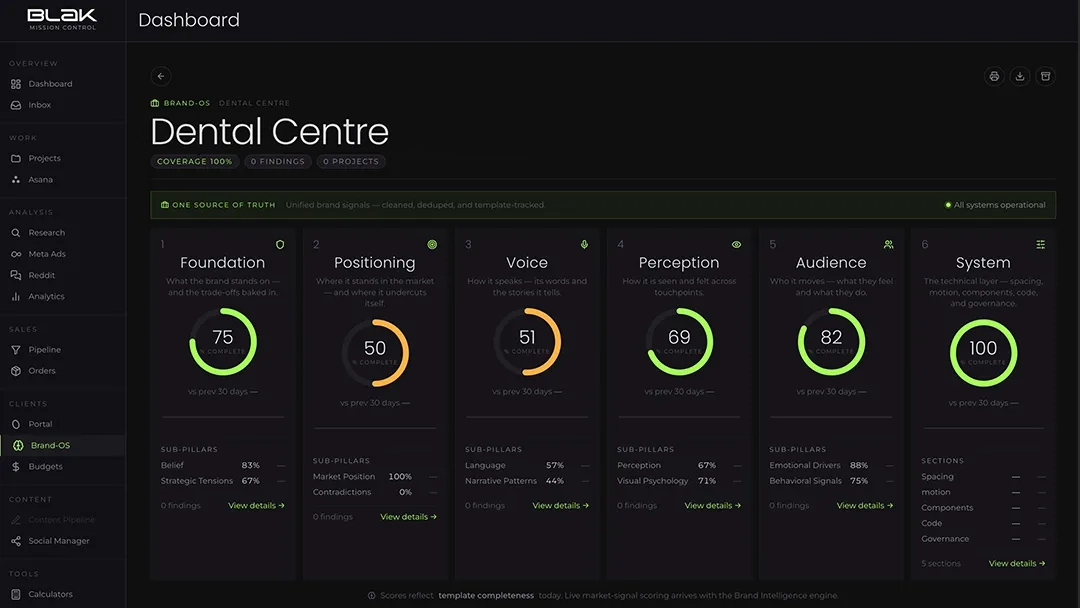
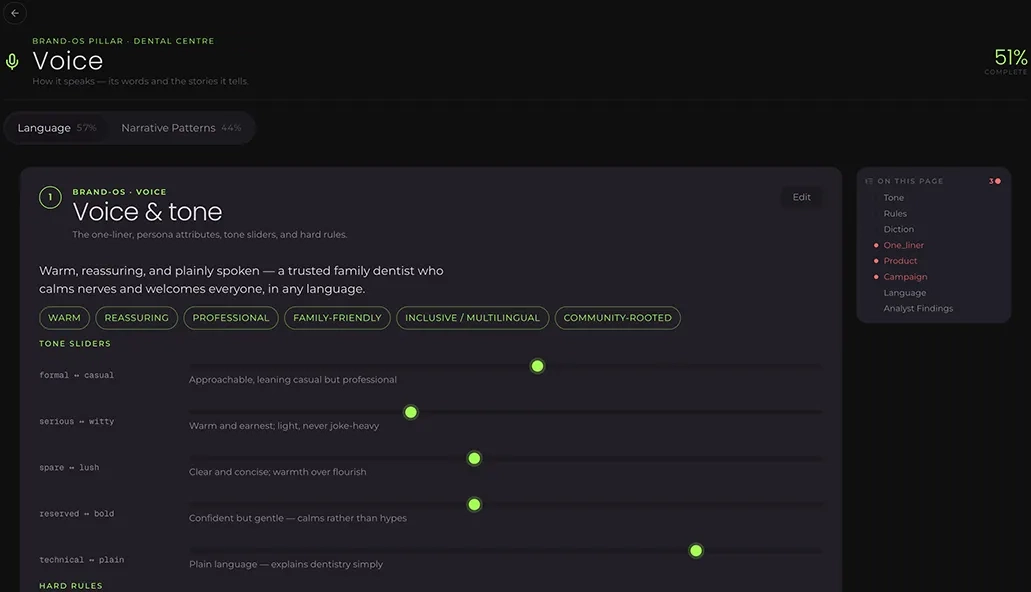
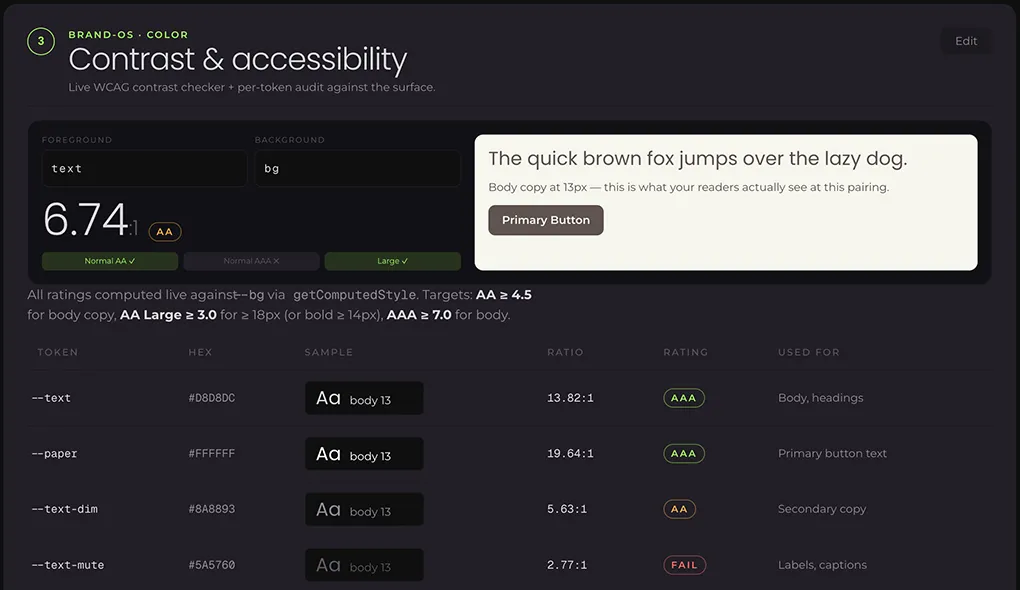
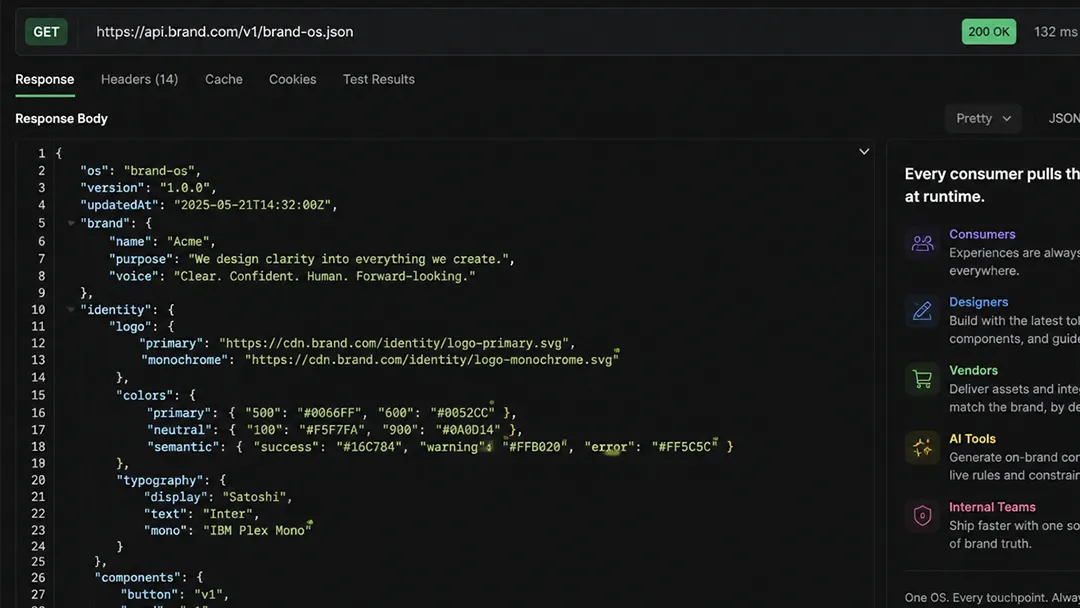
when a value changes, the change propagates. no version-control on PDFs. no "pull the latest file." the OS is alive.
08. questions.
quick answers to the questions that come up before a kickoff call. full list at /faq →
- What is a BLAK OS?
- A governed operating system for a brand. Strategy, identity, language, perception, and emotional posture encoded so every team and every vendor renders the brand the same way. Not a PDF style guide. A live system with machine-readable tokens, rules, and rendering specs.
- How is this different from brand guidelines?
- A style guide is a document. A BLAK OS is governance. The guide says "use this blue." The OS makes sure every consumer (designer, vendor, AI tool, internal team) pulls the blue from the same source of truth, so drift is structurally prevented, not policed.
- How long does an engagement take?
- Four phases. Diagnostic (two weeks), strategy and governance (three weeks), build (six to twelve weeks depending on module scope), then ongoing operate. Twelve weeks to a working OS is typical.
- What does it cost?
- Minimum engagement starts at $20,000 for a single-module build. Full BLAK OS engagements (all four modules + Mission Control operate) scale with company size and depth. We send a fixed quote after the first call.
- Who owns the OS after launch?
- You do. The OS lives in Mission Control, hosted by us by default. You can take over operation, keep us on retainer to run it, or both. The OS itself, including all source data and tokens, is yours.
- Can our internal team operate it without you?
- Yes. The whole point of the OS is that it runs without us in the room. Mission Control is a governance surface. Your team edits, approves, and publishes. We can train, advise, and hand-off, or stay on as the governance partner.
ready to talk? hello@blakinc.com →